.png?width=2048&height=2048&name=generated-image%20(6).png)
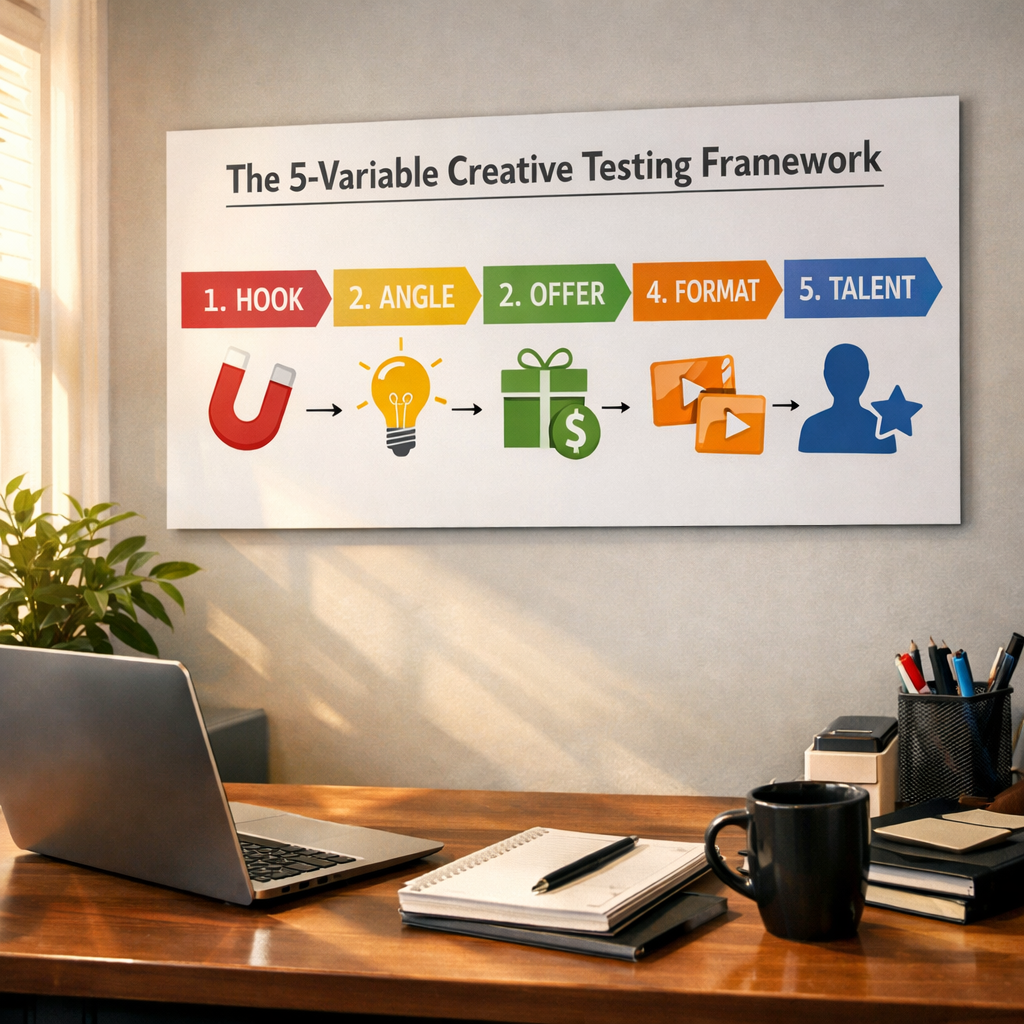
The 5-Variable Creative Testing Framework

You launched 10 ads last month. Some performed okay. Most didn't. And you have absolutely no idea why.
That's not a creative problem. That's a testing problem.
If you're a founder or marketing lead running $8k–$30k/month on Meta or TikTok, this scenario is painfully familiar: you brief your designer or UGC creator, produce a batch of creatives, push them live, stare at the dashboard for a week, and walk away with nothing conclusive. ROAS is flat. CAC creeps up. And the only lesson you can extract is "make more ads."
The real issue isn't volume. It's that you're changing too many variables at once — and when everything changes simultaneously, nothing can be learned.
Why Your Tests Keep Failing
Here's what most "creative testing" actually looks like at scaling DTC brands: new hook, new angle, new format, new offer, new UGC talent — all in the same batch, all live at the same time. When one ad outperforms the others, you can't explain why. Was it the hook that opened the pattern interrupt? The offer structure that reduced friction? The talent who felt more relatable? The format that suited the platform's algorithm that week?
You don't know. So you can't replicate it.
This is the creative testing trap. It produces the occasional lightning-in-a-bottle winner — but no compounding knowledge. Every quarter starts from scratch because your learnings live in your head as vibes, not in a documented system as evidence.
The fix isn't complicated. But it requires discipline.
Introducing the 5-Variable Test Cycle
The 5-Variable Creative Testing Framework isolates one creative element per test cycle, in a deliberate order. The sequence matters because each variable builds on the one before it.
The order is: Hook → Angle → Offer → Format → Talent
Here's what each variable means and why it's sequenced this way:
1. Hook — The first 1–3 seconds. Does this creative stop the scroll at all? Before you test anything else, you need to know whether your opening line, image, or visual pattern is earning attention. Hook testing is the cheapest and fastest test because it produces a clear binary: CTR and thumb-stop rate either move or they don't.
2. Angle — The core emotional or logical argument the ad is built around. Once you have a hook that earns attention, you test what story you're telling. Is the angle "social proof from people like me"? "Problem-agitation"? "Before and after transformation"? You hold the hook constant and change only the underlying argument.
3. Offer — The specific value proposition being made. Not the product — the framing of the product. "30-day free trial" vs "Start free today" vs "Cancel anytime" are three different offers for the same thing. Hold the hook and angle constant; change only how the value is packaged.
4. Format — The creative execution style. Static image vs. talking-head UGC vs. text-on-screen vs. product demo. Only test this once you have a validated angle and offer. Format tests often get run first in reactive creative sprints — this is backwards and expensive.
5. Talent — The person delivering the message. UGC creator A vs. creator B vs. founder-facing vs. customer testimonial. Talent is tested last because no matter how compelling the talent is, it can't save a weak angle or a confusing offer.
A Real Example: Wellness Supplement Brand
Say you're running a magnesium supplement brand targeting women 28–45. Here's what a structured 3-sprint test cycle looks like using this framework:
Sprint 1 — Hook Test (hold everything else constant):
Ad A: "Most women are unknowingly deficient in this one mineral"
Ad B: "I was waking up at 3am every night — then I found this"
Ad C: "Your sleep isn't broken. Your magnesium is."
Result: Ad C generates a 4.2% CTR vs 1.8% for Ad A. You now have a proven hook.
Sprint 2 — Angle Test (keep Ad C's hook, change the core argument):
Ad D: Hook C + problem-agitation angle (cortisol, stress, modern diet)
Ad E: Hook C + social proof angle (customer testimonials about sleep transformation)
Ad F: Hook C + authority angle (what sleep researchers actually recommend)
Result: Ad E produces the lowest CPL at $18 vs $31 for Ad F. Social proof angle wins.
Sprint 3 — Offer Test (keep hook + angle from Ad E, change offer framing):
Ad G: "Try a 30-day supply — free shipping"
Ad H: "Start your sleep reset for $1 today"
Ad I: "Join 14,000 women who fixed their sleep in 30 days"
Result: Ad I converts at 3.1x ROAS vs Ad G at 1.9x. Social framing in the offer matches the social proof angle — they amplify each other.
In three structured sprints, you've moved from 10 random ads to a validated hypothesis stack: Pattern-interrupt hook + social proof angle + social framing offer. That's a creative brief you can replicate, evolve, and hand to a UGC creator for the Talent test in Sprint 4.
How to Run This Without Losing Your Mind
You don't need a massive budget or a dedicated creative team. You need three things:
A written hypothesis before every test. One sentence: "We believe [variable] will outperform [control] because [reason based on customer insight]." If you can't write the hypothesis, you're not ready to test.
A minimum spend threshold. Don't read results before each ad has had at least $150–$250 in spend and 3–4 days of exposure. Early signals lie.
A log. A simple spreadsheet with: hypothesis, variable tested, winner, why you think it won, next bet. This is your creative intelligence library. After 90 days, it's the most valuable document in your business.
The Compounding Advantage
The brands that dominate their category on paid media aren't running more ads. They're running smarter tests. Each cycle builds on the last, narrowing the search space, compounding the learning, and producing a creative bank of 8–12 proven performers rather than a single fragile hero ad held together by hope.
You already know your current approach isn't working. You've felt the ceiling. The question is whether you want to keep guessing or start learning.
One variable. One test. One insight at a time.
That's how you build a creative engine — not a creative emergency.